How to Use Your Credit Card Abroad Without Hidden Fees
If you want to use a credit card abroad without hidden fees, choosing the right card is only part of the process. You also need to understand foreign transaction fees, currency conversion, dynamic currency conversion, ATM charges and other costs that can make an international trip more expensive.
A credit card that does not charge foreign transaction fees can help you save money, but it does not automatically mean that every international transaction is free. The way you pay, the currency you choose and the type of transaction can all affect the final cost.
Before your next international trip, use these strategies to avoid unnecessary fees and get the most value from your credit card.
How to Use a Credit Card Abroad Without Paying Hidden Fees
The easiest way to use a credit card abroad without unexpected costs is to follow a few basic rules:
- Use a card with no foreign transaction fees.
- Always choose to pay in the local currency when given the option.
- Avoid using a credit card for cash advances unless absolutely necessary.
- Check your card’s international fees before traveling.
- Decline unnecessary currency conversion at the point of sale.
- Monitor your account for unfamiliar charges.
- Carry a backup payment method.
These steps can help you avoid some of the most common costs associated with international credit card use.
Choose a Credit Card With No Foreign Transaction Fees
The first step to use a credit card abroad without paying unnecessary fees is choosing a card that does not charge foreign transaction fees.
Many credit cards charge approximately 3% on eligible purchases made outside the United States. The exact amount depends on the card’s terms.
For example, if you spend $3,000 internationally and your card charges a 3% foreign transaction fee, you could pay approximately $90 in additional fees.
A card with no foreign transaction fees can eliminate that specific charge.
Some popular travel cards with no foreign transaction fees include:
- Chase Sapphire Preferred.
- Capital One Venture Rewards.
- Capital One Venture X Rewards.
- Bank of America Travel Rewards.
- Wells Fargo Autograph.
However, benefits and fees can change. Always review the current terms before applying for a new card.
You can also read our guide to the Best Travel Credit Cards With No Foreign Transaction Fees in 2026.
What Is a Foreign Transaction Fee?
A foreign transaction fee is a charge that some credit card issuers add when you make a purchase outside the United States.
The fee may apply when:
- You buy something in another country.
- You pay a foreign merchant online.
- You make a purchase in a foreign currency.
The fee is usually calculated as a percentage of the transaction.
A common example is a 3% fee, although the actual amount varies by card.
For example:
Purchase: $1,000 equivalent
Foreign transaction fee: 3%
Additional cost: $30
If you frequently travel internationally, these fees can add up quickly.
Always Choose the Local Currency
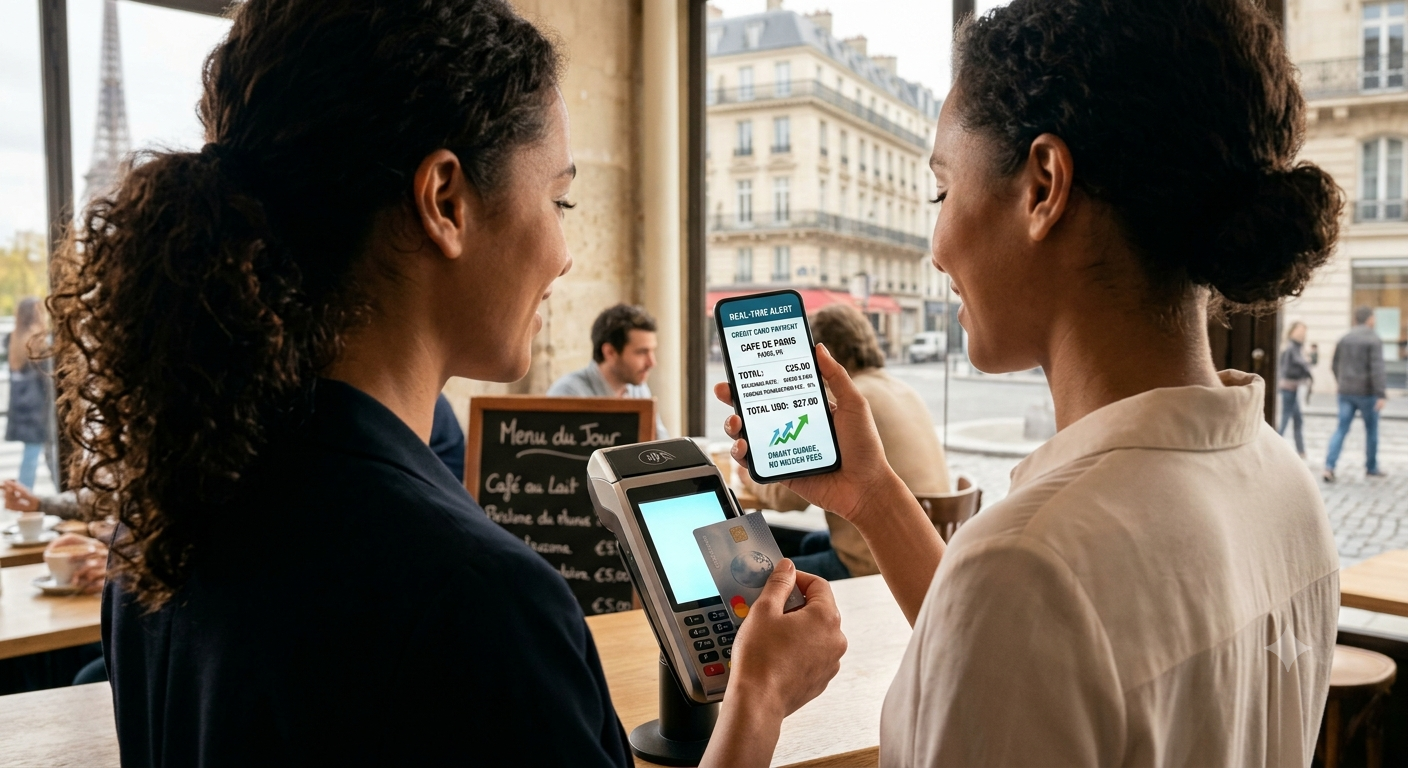
One of the most important rules when you use a credit card abroad is to pay in the local currency whenever possible.
For example, if you are visiting Japan, choose Japanese yen.
If you are visiting France, choose euros.
If you are visiting Mexico, choose Mexican pesos.
You may sometimes be asked whether you want to pay in:
- The local currency.
- U.S. dollars.
Choosing U.S. dollars may seem more convenient, but it can trigger a process called dynamic currency conversion.
What Is Dynamic Currency Conversion?
Dynamic currency conversion allows a merchant or ATM to convert a transaction into U.S. dollars immediately.
The problem is that the exchange rate used may be less favorable than the exchange rate provided through your credit card network.
The transaction may also include an additional markup.
For example, a merchant may ask:
“Would you like to pay in USD or local currency?”
If you choose USD, the merchant may determine the exchange rate.
If you choose the local currency, the transaction is generally converted through the payment network associated with your card.
For many travelers, choosing the local currency is the better option.
Why Paying in U.S. Dollars Abroad Can Cost More
Imagine you are buying an item in Europe.
The purchase costs €100.
The merchant gives you two options:
- Pay €100.
- Pay the equivalent amount in U.S. dollars.
The dollar amount may look convenient, but the exchange rate selected by the merchant could be less favorable.
The difference may be small on one transaction.
However, if you make multiple purchases, the additional cost can become significant.
This is why many experienced travelers choose the local currency when using a credit card abroad.
Avoid Credit Card Cash Advances
Using a credit card to withdraw cash abroad can be expensive.
A cash advance may involve:
- A cash advance fee.
- An ATM fee.
- A potentially higher APR.
- Interest that begins accruing immediately.
A credit card with no foreign transaction fee does not necessarily provide free international ATM withdrawals.
The absence of a foreign transaction fee does not eliminate other cash advance costs.
For this reason, using a credit card for everyday purchases and using an appropriate debit card or travel account for cash withdrawals may be a better strategy.
Do Not Assume Every ATM Is Free
Even if your credit card issuer does not charge a foreign transaction fee, the ATM operator may charge its own fee.
You may encounter:
- ATM operator fees.
- Cash advance fees.
- Currency conversion fees.
- Other charges.
Before accepting a cash withdrawal, review the displayed fee.
If the fee seems excessive, cancel the transaction and look for another option.
Should You Notify Your Credit Card Company Before Traveling?
Some credit card issuers allow or recommend travel notifications.
Others use automated fraud detection systems and may not require you to notify them.
Policies vary.
Before traveling internationally, check your issuer’s current policy.
It can also be useful to confirm:
- Your card is active.
- Your contact information is current.
- You know how to contact the issuer internationally.
- You have access to your mobile banking app.
Unexpected transactions in another country can sometimes trigger fraud alerts.
Having your issuer’s contact information available can make it easier to resolve a problem quickly.
Carry a Backup Payment Method
Even if you plan to use a credit card abroad, you should not rely on only one payment method.
A card may:
- Be declined.
- Get lost.
- Be blocked because of suspected fraud.
- Stop working because of a technical problem.
Consider carrying:
- A second credit card.
- A debit card.
- Some local currency.
- An emergency payment method.
Keep your backup card separately from your primary card.
If your wallet is lost or stolen, having another payment method available can be extremely useful.
You can learn more about what to do in that situation in our guide to What to Do If Your Credit Card Is Lost or Stolen.
Check Your Credit Card’s International Acceptance
Not every credit card network has the same level of acceptance in every country.
Before traveling, research whether your card is commonly accepted at your destination.
Visa and Mastercard are widely accepted internationally, but acceptance can still vary depending on the country and merchant.
Discover acceptance may also vary in some international destinations.
If you plan to travel internationally, carrying a backup card from a different payment network can reduce the risk of being unable to pay.
Avoid Paying With a Debit Card When a Credit Card Is Better
A debit card takes money directly from your bank account.
A credit card generally gives you additional protections against certain unauthorized transactions.
Credit cards may also offer:
- Travel rewards.
- Purchase protections.
- Travel insurance benefits.
- Fraud monitoring.
However, the specific protections depend on your card and its terms.
When you use a credit card abroad, check the card’s benefits before traveling.
Some cards may provide protections for:
- Rental cars.
- Trip cancellations.
- Lost luggage.
- Travel accidents.
Not every card includes the same benefits.
Check Your Card’s Foreign Transaction Fee Before Traveling
Do not assume that every travel card has no foreign transaction fees.
Some cards charge fees even if they offer travel rewards.
Before you travel, review:
- Foreign transaction fees.
- Cash advance fees.
- Cash advance APR.
- Annual fee.
- Travel benefits.
The information is usually available in the card’s pricing and terms.
If you are unsure, contact the issuer directly.
Understand the Exchange Rate
When you use a credit card abroad, the transaction usually needs to be converted into U.S. dollars.
The exchange rate can affect the final amount charged to your account.
The exchange rate may depend on:
- The payment network.
- The date the transaction is processed.
- The currency involved.
The amount you see at the time of purchase may not always exactly match the final amount shown on your statement.
This is normal in some situations because currency exchange rates can change.
Avoid Unnecessary Currency Exchange at Hotels and Merchants
Hotels, restaurants and merchants may sometimes offer to convert a charge into U.S. dollars.
This can seem helpful.
However, the conversion may use a less favorable exchange rate.
If you have a card with no foreign transaction fees, paying in the local currency may allow the card network to handle the conversion instead.
Always review the payment screen carefully before approving the transaction.
Review Your Receipts
After making a purchase abroad, check the receipt.
Look for:
- The amount.
- The currency.
- Any additional fee.
- The exchange rate, if displayed.
This can help you identify a problem before leaving the merchant.
If the receipt shows an unexpected conversion or fee, ask questions before completing the transaction.
Monitor Your Account While Traveling
When you use a credit card abroad, check your account regularly.
You do not necessarily need to check it after every purchase, but reviewing your transactions periodically can help you identify:
- Unauthorized transactions.
- Duplicate charges.
- Unexpected fees.
- Incorrect amounts.
Most major card issuers allow you to monitor transactions through a mobile app.
You can also enable notifications for new purchases.
Be Careful With Hotel and Rental Car Deposits
Hotels and rental car companies may place temporary holds on your credit card.
A temporary authorization hold can reduce your available credit even though the final amount has not been charged.
This can be important if you are traveling with a card that has a relatively low credit limit.
Before checking into a hotel or renting a car, ask whether the company will place a deposit or authorization hold.
The amount and release time can vary.
What to Do If Your Credit Card Is Declined Abroad
If your credit card is declined while traveling:
- Check your mobile banking app.
- Look for a fraud alert.
- Confirm that the card is not locked.
- Contact the issuer.
- Try another payment method.
Do not immediately assume that the card has been permanently blocked.
A transaction may be declined because of:
- Fraud detection.
- Merchant restrictions.
- Technical problems.
- Incorrect payment information.
Having a backup card can make this situation much easier to handle.
Can You Use a Credit Card Abroad Without Internet Access?
You can often make card purchases without having internet access on your phone.
The merchant’s payment system may process the transaction independently.
However, internet access can be useful for:
- Checking your account.
- Receiving security alerts.
- Contacting your issuer.
- Locking your card.
Before traveling, make sure you know how to contact your issuer if you lose access to mobile data.
How to Avoid Hidden Fees When Using a Credit Card Abroad
If you want to use a credit card abroad without unexpected costs, use this checklist:
Before your trip
- Check the foreign transaction fee.
- Check cash advance fees.
- Confirm your card is active.
- Download your issuer’s mobile app.
- Save the international customer service number.
- Pack a backup payment method.
During your trip
- Choose the local currency.
- Avoid unnecessary cash advances.
- Review payment screens carefully.
- Check receipts.
- Monitor your account.
After your trip
- Review your statements.
- Look for unfamiliar transactions.
- Check for unexpected fees.
- Report errors to your issuer.
Common Mistakes Travelers Make With Credit Cards Abroad
Choosing U.S. dollars at checkout
Dynamic currency conversion can result in a less favorable exchange rate.
Assuming no foreign transaction fees means no fees at all
ATM fees, cash advance fees and other charges can still apply.
Carrying only one card
A declined or lost card can create serious problems.
Using a credit card to withdraw cash
Cash advances can be expensive.
Not checking the card’s terms
The fees and benefits vary between cards.
Ignoring account alerts
Fraud can happen anywhere, including while you are traveling.
How to Use a Credit Card Abroad Without Hidden Fees: Final Verdict
Knowing how to use a credit card abroad can help you avoid unnecessary costs during international travel.
The most important steps are choosing a card with no foreign transaction fees, paying in the local currency and avoiding credit card cash advances whenever possible.
You should also review your card’s terms before traveling, monitor your account and carry a backup payment method.
The best strategy is not simply to find a card with no foreign transaction fee. You also need to understand how currency conversion works and recognize that other fees may still apply.
With a little preparation, you can use your credit card internationally with fewer surprises and keep more of your travel budget for the trip itself.
Frequently Asked Questions
Can I use my credit card abroad without paying fees?
Yes, if your card does not charge foreign transaction fees and you avoid other costs such as cash advance fees, ATM fees and unfavorable currency conversions.
Should I pay in U.S. dollars or local currency abroad?
In many situations, paying in the local currency may be preferable because it allows the card network to handle the currency conversion rather than the merchant or ATM.
What is the best credit card to use abroad?
The best card depends on your needs. A good international travel card may offer no foreign transaction fees, useful rewards and benefits that match your travel habits.
Do credit cards charge more abroad?
Not necessarily. A credit card with no foreign transaction fee may not charge an additional fee for eligible international purchases. However, other fees may apply.
Can I use a credit card at a foreign ATM?
You may be able to, but the transaction could be treated as a cash advance. Cash advance fees and interest may apply.
Should I carry cash when traveling internationally?
Carrying a small amount of local currency can be useful as a backup. However, the appropriate amount depends on your destination and personal preferences.
Why was my credit card declined abroad?
Your card may have been declined because of fraud protection, technical issues, merchant limitations or other account-related reasons. Contact your issuer if the problem continues.
Is dynamic currency conversion a hidden fee?
Dynamic currency conversion is not necessarily a hidden fee, but the exchange rate and additional markup may make the transaction more expensive than paying in the local currency.
Should I tell my bank before traveling internationally?
Some issuers may recommend a travel notification, while others use automated fraud monitoring. Check your issuer’s current policy before your trip.
What should I do if my credit card is lost abroad?
Contact your card issuer immediately, lock or cancel the card if necessary and use a backup payment method. You can also review our guide on What to Do If Your Credit Card Is Lost or Stolen.
Keep Reading
- Best Travel Credit Cards With No Foreign Transaction Fees in 2026
- Best Credit Cards for Earning Airline Miles and Points
- What to Do If Your Credit Card Is Lost or Stolen
- Capital One Venture Rewards Review: Benefits and Requirements
- Chase Sapphire Preferred Review: Is It Worth the Annual Fee?
Editorial note: Credit card fees, rewards, benefits and issuer policies can change. Always review your card’s current terms before traveling. This article is for informational purposes only and does not constitute personalized financial advice.